


Attractions Expert Q&A: Chris Runco designed the RX-24 robot pilot for Star Tours, Grizzly River Run at California Adventure, and Typhoon Lagoon at Disney World
Chris Runco had many careers in the 40-plus years he worked at Walt Disney Imagineering, beginning as a Model Designer in the legendary WED Model Shop and later becoming a Show Designer and Principal Concept Designer, creating characters (RX-24 robot pilot for Star Tours), rides (Grizzly River Run at California Adventure), shops, restaurants and an entire theme park (Typhoon Lagoon at Walt Disney World).

As a Creative Director, Chris guided teams in designing and building lands and attractions, including Tokyo Monsters, Inc. interactives and Pirates Lair on Tom Sawyer Island. Since retiring from Disney, Chris has designed attractions for parks in China, Saudi Arabia, and the U.S. and served as a guest lecturer at the University of Southern California. He also volunteers as a theatrical Production Designer and Set Designer for the Assistance League of Los Angeles, art directing children’s theater.
What theme park souvenir might we be surprised to find on your shelf, and what’s its story?
I have part of one of the original Jungle Cruise exit signs, which was mounted to the tree that used to sit outside the exit. When I was art directing the renovation of the Boathouse, it was simultaneous with the work building the Indiana Jones ride next door to Jungle Cruise, and that was fun because I got to go over and watch their progress.

We had to do some demolition, and I asked the guys if they could save that sign. All those original hand-painted signs at the park are so wonderful. I came back a couple of hours later, and the guy handed me this piece of wood and said, “Well, unfortunately, the guy with the Bobcat tractor went right through it. Here’s half of it.” So, I have the top half of the sign, but nobody could find the bottom part. It says, “Jungle Cruise Ex.”
The other one I think is really cool is that I have a handmade blacksmith’s hinge. There was a fence everybody will remember between the fort and the back half of Tom Sawyer’s Island. And the signs said something like “hostile territory,” and “no entry,” on this rugged old fence. That was one of the first things we knocked down when we were doing the renovation for the Pirate’s Lair overlay. I was out there working and found the hinges from the gate in the pile of rubble. They had this massive gate, like eight feet wide. And I looked at the hinges and they’re really interesting, just real thick hammered iron. And I thought, that’s probably a handmade from Tom Sawyer Island’s Opening Day, so I’ve held onto that.
What theme park have you always wanted to visit but have never been to?
One of the things I really enjoyed – especially in the last years I was at Imagineering – was going to the Themed Entertainment Association (TEA) conferences. There’s so much wonderful work going on all over the world now.
One is Puy du Fou (in France) – when I saw the images, I thought, “This looks phenomenal. I’ve really got to see that.” It’s on the top of my list. Also, the Raving Rabbids: The Time Machine attraction at Futuroscope. That Rabbids attraction just looked fantastic – that’s the one where you ride on toilets. It’s so much fun at the TEA events to talk to the people who created these things, as they are usually very open about everything they went through.

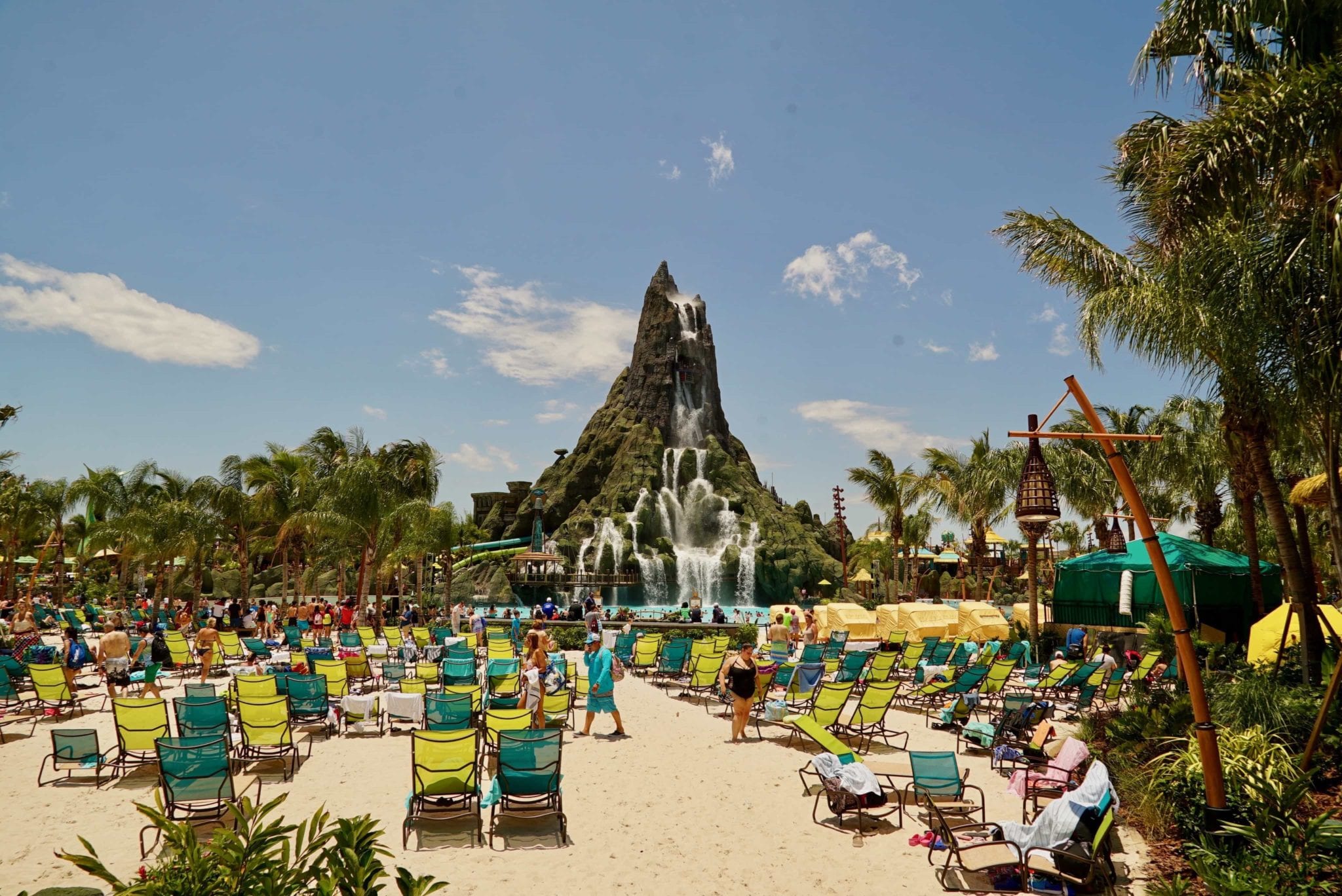
I would really love to see Volcano Bay because I love water parks, and I met the designers at a TEA conference in New York. One of the things they told me was that they were inspired by Typhoon Lagoon, and I told them I was the show designer for that park. It made me very happy! That was really cool.
I have to include Efteling, and for that matter, historically, Tivoli Gardens – to see part of what inspired Walt. And finally, Epic Universe looks like it’s going to be phenomenal.
Was there a theme park or attraction that made you want to be in this industry, and how did it inspire you?
I lived in La Habra, a half hour from Disneyland. We loved that when we were kids and would go about once a year. I remember driving down the freeway before Orange County was really built up, and we’d be looking out the car windows, and suddenly, the Matterhorn would loom over the trees, and we knew we were there. Now, you can’t see any of that.

But I really fell into the business. I was going to college and didn’t know there were such jobs as theme park designers. My high school art teacher said to me, “You’re interested in science, and you’re interested in art. Why don’t you become a medical illustrator?” But I wasn’t really thrilled about the idea.
During my first summer in college, I needed a job, and I thought I would apply at Disneyland, so I applied to be a ride operator. The guy called me in for an interview and said, “I see here that you do caricatures.” I told him that I did. He asked if I could do portraits, and I said, “Sure!” I was 18, and I had done a lot of different stuff in art, but I hadn’t really done many portraits, but when he asked if I could do them, I decided to think positively.
The supervisor from the Art Festival came into the room. He brought me some chalk and paper and said I should do some samples and bring them back in a couple of weeks. So, I went back to college, drew everybody in the dorm, and came back two weeks later, and the guy looked at my stuff and said, “Okay, when can you start?” School ended at the beginning of June, and I was on Main Street the next week, drawing portraits. It’s when there was the Art Festival. I have John Hench’s original sketch of the Art Festival and had him autograph it for me. But, yeah, that was my summer job through college.
What was your favorite ride or attraction as a child, and why?
There are a few. First, Peter Pan. I remember it from when I was really young, and that flying pirate ship is just so wonderful to this day. Ray Bradbury wrote a letter to Walt after visiting Disneyland (and Peter Pan’s Flight) and said, “Walt, I will be eternally grateful that you made it possible for me to sail from a child’s window, out over moonlit London in a galleon on its way to the stars!”

It was so heartfelt. Ray Bradbury loved Walt, and they remained connected. Ray visited WDI, and we talked to him a couple of times. There’s a wonderful page that Ray wrote about the spirit of Imagineering that I probably have buried somewhere. Ray helped on Spaceship Earth when we were first designing it for Epcot. He was good friends with John Hench, and they worked together on one of the first iterations—really fascinating guy. I have always loved his books.
Besides the wonderful Peter Pan ride, I love the teacups (Mad Tea Party). I remember going to Disneyland for Grad Night in high school. Several of my buddies and I got in one of the teacups and spun it so fast that we could not get out of the teacup. When it was over, the ride operator had to come over and take the rope off. Before they had doors, there was just a rope, and we were so dizzy we couldn’t unclip it. They may have toned the ride down now, but that was fun.

And the last one – and I think this is really the one that’s a special childhood memory – is Nature’s Wonderland. I always remember going around Nature’s Wonderland, riding the mine train next to the river, through Cascade Peak, out over the lake, seeing the bears, and then sweeping through the Painted Desert with the teetering rocks. And then Rainbow Caverns with the beautiful black light environment that I still have a vivid memory of – it was remarkable. And next to it, which is still part of Rancho del Zocalo, the facades were originally stores. The one right next to the Big Thunder Ride was called Mineral Hall. I forgot if that sign is still there, but it was full of displays of geodes and wonderful crystals. There are a lot of minerals that you can hit with a UV light, and they glow. There are so many things in that park that are there because someone loved them. I bet somebody in that group of original Disney designers had a wonderful rock-hunting hobby that they loved, and Walt said, “Let’s throw it in.”
I remember going to see that ride when I was a kid, and then, decades later, I was part of the crew that built Big Thunder Mountain Railroad. And I can still recall going there the day we shut it down and walking the area to get ready to put Big Thunder in. It was amazing because you would walk along the track where the little lake was, which is still there.

The lake is across the bridge from Big Thunder, and it’s from Nature’s Wonderland. And you couldn’t believe you were in Anaheim. It felt just like a High Sierra Forest. It was incredible. And we saved things, like the little town that was there. We saved those buildings and made them part of the little town at the end of the Big Thunder ride. So, to walk it was such a piece of history.
Was there a ride, attraction, or character that frightened you as a child?
I think the Matterhorn. It was the first coaster I’d ever been on, and it was so thrilling. And that’s when there was no interior. When you went inside the mountain, it was just steel.
What was the oddest or coolest job you’ve had in your career?
The oddest one that I can think of was that I once designed a “Toilet of the Future” for Epcot. There was a company that designed street-side pay toilets that they have in France and, I think, San Francisco. It looks like a really big phone booth. They were talking about sponsoring something, so we did an exhibit, including the history of toilets for CommuniCore. At the time, there were small exhibits, like the robot arm from Panasonic, that drew pictures. So somewhere, there’s my artwork in the WDI archives of a toilet of the future.
As far as one of my coolest jobs, I grew up with Tom Sawyer Island. I loved it, and I brought my kids there, and they loved it. When Matt Ouimet and Greg Emmert were running Disneyland and really refreshed it around 2005, they brought the whole park back up to snuff. They came to us and said, “What can we do with the island? Everybody’s going to the Tomorrowland side, and we’re not getting enough people on the west side. The island’s getting underutilized—let’s do something with it.” We’d worked on many ideas over the years but knew it needed help and an upgrade. So, Ray Spencer and I put together a whole bunch of concepts for Tom Sawyer Island. And then a month later, they looked at it and said, “Well, that’s great, but we can’t fit it on the production menu, so never mind.”
We set it aside, and about a year and a half later, we got this urgent call from our executives who said that Jay Rasulo wanted to put pirates on Tom Sawyer Island, and he wanted it to coincide with a film that was opening in six months. They asked if I still had those ideas. I was kind of a pack rat, and I’d held onto them. So, we whipped out the designs, and Ray and I fleshed them out and brought them in a week later. Our executives looked at it, and I’ve never seen them so anxious because they knew that opening it at the same time as the film would be a real struggle.
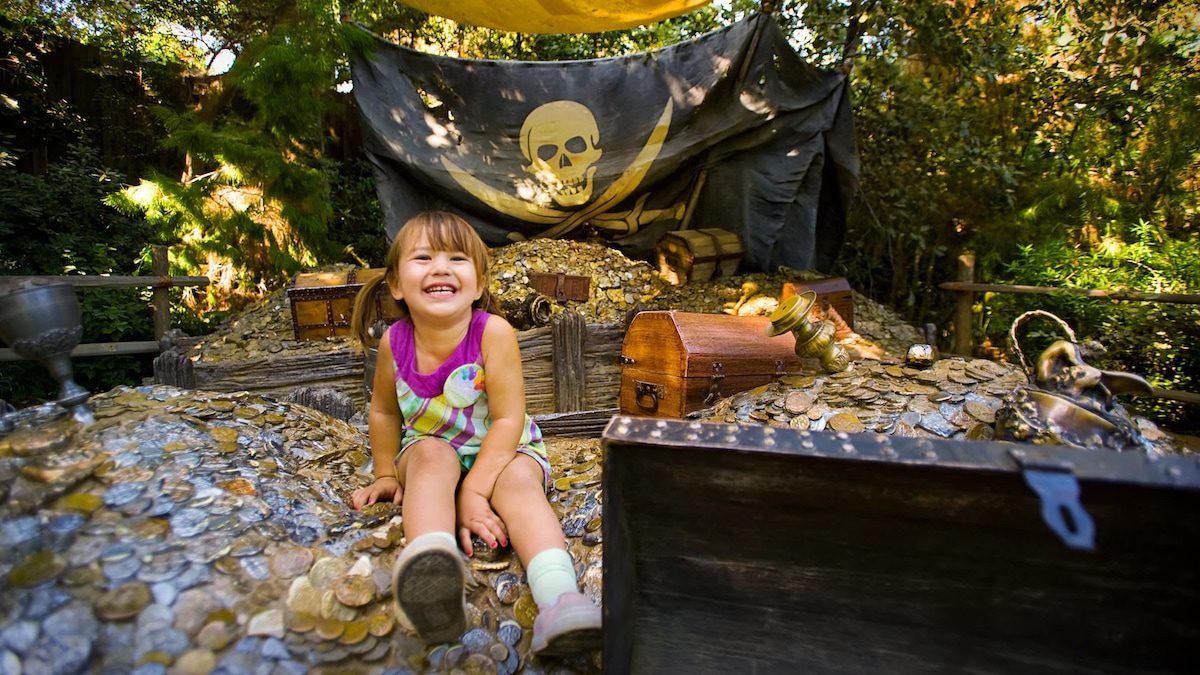
It was like Jay Rasulo was in the room with his checkbook out, saying, “Okay, how much is it going to be?” And we were off and running. They said just start designing and start building. So, we were working on Tom Sawyer Island, and I remember thinking, I love this attraction, and it’s so cool to be here, bringing it back to life.
At the time, I was living in Burbank and would take the train down to Anaheim. From the train, I’d get on a bus to the park, walk through the park, ride a bike to the office behind Indiana Jones, then ride the bike to Critter Country because the park wasn’t open yet. And then I would hail down the raft, which would come over and pick me up and take me out to the island. We’d spend all day working on the island. The construction crews would work from five or six in the morning to three in the afternoon and leave. As art directors, we usually hung around to figure out what to do the next day. So, I’d be there until dusk, and the raft driver would stick around all day. I’d call him and say, “Hey Henry, bring the raft over. Let’s take a ride. I want to go see the other side and take some pictures.” So, I’d get my own ride in the raft around the island.

Then I’d go back to the island and literally be the only person on the island at that point—just me and the ducks, walking around, climbing in the caves. And I’d think this is a young kid’s dream come true!
Walt himself worked on the island the first year it opened, which was a year after the park opened. The island was there, but there was nothing on it. In early pictures, the trees were about three feet tall. Marvin Davis (Disneyland master planner, art director, and scenic designer) said that one day in a meeting, Walt actually sketched the island out. “Put a bay here and another bay there.” And he even called one of them Pirates Cove, interestingly enough. He did a little pencil sketch, which they used as a guide. There are pictures of him on the island while the guys are building it. Walt was always on site in that first year, staying in his apartment. And he was constantly walking around, seeing how things worked and being a part of everything being built. So, his stamp was on the island. I will always feel thrilled and honored to have been a part of it.
The fort itself was a wonderful piece of architecture. There’s a great story of how they built the fort in that first year. The river was there, and the Mark Twain Riverboat. And they said, “Okay, we have to build a fort, and we’ve got this huge pile of logs. How are we going to get the logs out to the island?” Even those huge cranes weren’t big enough to lift the logs over the river. They thought they were going to have to shut the river down. Then somebody said, “Wait a second, guys. When they built this stuff back in the 1800s, they floated the logs across the water.” So, they tied the logs together, floated them across the river, and pulled them out, and that’s how they built the fort.
The fort was built very authentically—the notched logs and the whole construction of it. I loved the fort. It was great and had a headquarters with Davy Crockett and Andrew Jackson inside. We would go on the upper deck, up the sturdy block houses, and across the parapets where you looked out over the river. When the Columbia came by, they would fire off their signal cannon, which is a small cannon on the bow. There was also one on the fort, and the operator at the time, who’d be dressed in a cavalry outfit, would fire their signal cannon back.
And there was also a hidden cave. If you went to the back of the fort, a door opened into a secret chamber, leading to a tunnel that went down into the existing tunnels and out to the river. It was like a secret passage. We closed that permanently when we completed our renovation. But that cave is still there on the east side of the fort. So, there were always these fun little discoveries.
I was also the lead designer for Grizzly Peak at California Adventure, including the Rushin’ River Outfitters and Redwood Creek Challenge Trail. I grew up camping in the High Sierras every summer. Actually, our whole team had done a lot of camping. It was a labor of love for all of us working on Grizzly Peak.

Redwood Creek Challenge Trail at California Adventure is designed with rope climbs, bridges, and towers, all themed to a national park. But it was our version of Tom Sawyer’s Island – it was a playground for kids who had been in queue after queue and ride after ride. I think those physical play elements are really important for kids in the whole theme park experience. In fact, I read somewhere about the nature of physical play and how it helps kids learn and grow, and even the element of responsible risk in play is educational.
What ride or attraction do you think everyone needs to experience and why?
My biased answer is Grizzly River Run because it’s so much fun to go river rafting with your friends and watch them get soaked. I’m very proud of that ride and worked on it with the great WDI engineer, Mark Sumner, who taught us how to design the hydraulics of a water ride. Mark is such an incredible engineer—he just had such a great feel. He and I were designing the layout of the Grizzly River Run, and I wanted a lot of turns. I loved it when the raft spun, so we figured out how to do that and where to put the rapids in. He showed us how to design rapids and something called a hydraulic jump, which is fascinating. He actually brought in a physics class water tank that you could tilt and move around to create waves and explained the science behind building rapids and waves.
It’s the slope you take, the barriers you put in, and the way it flows. You have fast water, then go into slow water, then back to fast water, and that’s why the raft bounces and twirls. We planned virtually all of it, although it ended up having more spins than I even imagined, which I was very happy with. We talked about how, in winter, we didn’t want to get people quite as wet, so we might make the rapids adjustable. But we never did it because nobody cared—they never minded getting wet.

It’s one of the most fun things to do, and California has some of the best river rafting in the world. People come from around the world to ride the Kern and the Klamath rivers. I took my sons there as part of my research. I used a lot of the photos from that trip to design the queue, the theming, and the props.
But the other attraction that Mark Sumner designed—and this is the one I’m going to say everyone should experience—is Soarin’ Over California. It is such an emotional and exhilarating experience, with the music and the way it was done.
I’ll give you an anecdote: My aunt and uncle live in rural Oregon. They’re in their 90s now, but 20 years ago, they came down to visit, and they’re not big on cities and they’re not big on theme parks. But my mom told them, “You’ve got to go see the theme park that Chris worked on, and we’ll have a good time.” And, of course, they were very leery of any rides. They were in their late 70s at the time, and they didn’t want to go. My mom told them, “You have to ride Soarin’ Over California.” So, very timidly, they got on the ride and were really worried. I said, “You go up in the air, but you’re buckled in, so it’s okay.” When we got off the ride, my aunt turned to me, and she had tears streaming down her face. She said, “That was so beautiful. I loved it!” And my uncle said, “Can we do it again?” So, I thought, well, there’s a great review!

I believe Mark was the lead engineer, and he told me some amazing stories about working on that attraction. The project was almost scrapped because they couldn’t figure out the ride system. But Mark had an Erector Set at home, and one weekend, he used his Erector Set to come up with the Soarin’ mechanism. He brought the model to show us how the seats started on the ground and then moved up. And that model is still together—Disney kept it.
After the ride opened, all of us were interviewed about the making of the rides—the whole team. When Mark was interviewed, he talked about building Soarin’ with his Erector Set, and they showed off the model. A month later, he got a package from the Gilbert Toy Company, which owned Erector Sets. They wrote, “We are so thrilled that you used our historic toy for your design, that we thought we should make sure you still had all that capability.” And they had looked at the pictures of his design and gave him a box of Erector Set parts to replace everything he’d used to make that model. He’s quite a character. I worked with a lot of wonderful, talented people.
So, I love all of the rides. I love Pirates of the Caribbean—everybody’s got to see Pirates. It’s still the classic of all time, but I think my favorite is Soarin’ because of the emotional experience of flying and that beautiful score. I still get chills when I hear the music.
If you were tasked with creating a new theme park food, what would it be?
One of the jobs I loved dearly was when I art directed the Monsters Inc. Ride. Robert Coltrin and Kevin Rafferty designed this re-imagining of the ride that should not be named (otherwise known as Superstar Limo), and they did a beautiful job of turning it into the Monsters Inc. Ride. I got the job of art directing its construction and installation.

When they finished the one in Tokyo, they realized they needed to upgrade the game aspect–it’s flashlight tag with the Monsters. It’s wonderful, absolutely beautiful, and much bigger than the one here. They wanted an overlay that was all interactivity, and so I got to conceptualize and art direct this whole overlay of the Tokyo Disneyland Monsters Inc. ride. I also worked on the Monsters Inc. roller coaster concept, which I understand they’re actually now going to build in Florida. We worked on it about 15 years ago, and it has never gone anywhere, so it would be cool to see that happen.

I love Monsters Inc. and met Pete Docter–the amazing director and leader. That movie was his baby. In fact, we had this wonderful moment when he came down to visit us in Anaheim, and he said how cool it was to walk through the ride and see this story that he’d worked on come to life. And I had him art direct the position of the octopus sushi chef in Harryhausen. The characters become like family when you spend months with them like that.
So wouldn’t it be fun to have Monsters Inc.-themed food? I was thinking you could have an ice cream sundae, but it’s got an eyeball like Mike, or you could have food that was monster-shaped like Randall, but then as you start eating, it turns colors. The straws could look like snakes. And burgers with teeth, so it looks like they’ll bite you back. I think Monsters Inc.-themed food would be fun. And If they’re actually building a Monsters Inc. ride in Florida, they really ought to create a Monsters Inc. café.
You’re a walk-around character for a day; who do you choose?
I actually did that once in one of those orientation programs they had for WDI. I was Tweedledum or Tweedledee (I don’t remember which), but it was fun. It was crazy because people talk to you like you’re an old friend.
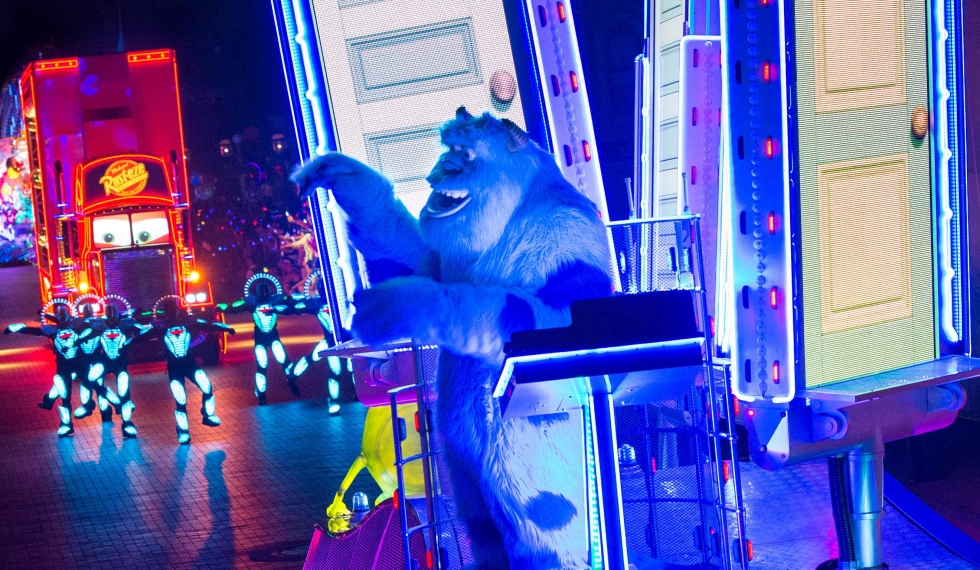
But I think I’d be a Monsters Inc. character. I’m probably not big enough to be Sully, but I obviously couldn’t fit in Mike. That would be fun to be Sully. You can’t beat Monsters Inc.– the music, characters, the love in it. It has so much heart.
What types of attractions would you like to see more of and why?
There’s a place for these incredibly intricate rides like the Mario Kart ride that just opened or Rise of the Resistance. Those are spectacular. Of course, Pirates is the granddaddy of them all. You can’t go wrong with those. But I also like simple rides. I think we don’t do enough of them. I love a good-themed round ride, like Dumbo and Rocket Jets.

I think the combination is great to have not only our Pirates of the Caribbean, Haunted Mansion, Rise of Resistance, and then to have a Dumbo ride or Teacups–the richness of all those things together is really wonderful. So, I love a good, simple ride. The Disney engineers had all kinds of ideas for innovative round rides.
One that I’d love to see is the Carrousel of the Marine Worlds on the Île de Nantes in France, the double-decker, Jules Verne-themed, steampunk, multi-layered carousel. Those are the same folks who did the incredible walking elephant that was about 50 feet tall. The pictures and the video are amazing. I have to go there sometime.
Was there any challenge or surprise in your career?
I was the art director for the Submarine Ride rehab at Disneyland. It was the first time– and the last time– they did a wet rehab, meaning they didn’t take the water out. Usually, they would drain it, repaint everything, put everything back in—the kelp and fish—and then fill it back up again. But they decided we didn’t have the budget. We were going to see if we could do the job while keeping the water. And it was the first time I’d ever art directed in the field, so it was quite an experience.
They would park the submarine, and my job was to take our little rowboat out to the sub, climb on, go inside, and look out the porthole. And the divers would come up—the maintenance guys in their dive suits. And I would do little drawings saying, “Put three fish on that rock like this.” Then they’d drill a hole, put in underwater epoxy, and glue the fish on. Then I’d say, “Put the kelp over there,” and do a little arm wave. We tried doing an underwater audio system; it was lousy, and nobody could understand anyone. So, I’d draw a rock with fish on it, and they’d nod to me. I’d row out with a boat full of kelp tied to weights and throw it over the side where I wanted them, and they’d sink down to the right spot.

Leota Toombs was also working on it, painting all the fish. Everybody loved her. She was in the model shop and was one of those craftspeople like Harriet Burns and Joyce Carlson who built Tiki Birds and the “It’s a Small World” dolls and painted them. And what she was doing at the time was the fiberglass fish. Unfortunately, they would often fade badly over time, sitting in that heavily chlorinated water. So, they tried casting them in ceramic, then painting them with ceramic paint and firing them. I think it seemed to hold up well.
That ride was very hard on props because they had to hyper-chlorinate the water to keep it safe and clear. You didn’t want to be in that water too long. One day, the Maintenance team took me backstage at the end of the shift and gave me a scuba suit, and I got to walk the whole sub ride with them. I had a weight belt, just like you would as a diver. I wore just enough weight so I would sink to the bottom with a pair of tennis shoes on and walk along the sea floor. It was fascinating to see all of it from that point of view. How many people get to do that?
Can you talk about what you are working on these days?
I’m happily retired. I have done a few design jobs for various theme park companies. And I paint; I do watercolors; I draw cartoons for people.
My favorite project I’ve done is immersive theater, and I absolutely love it. I go to every one I that can. I did an immersive Macbeth for a Shakespeare group in LA, which was really fun, where we turned their whole warehouse into the many castles and scenes of Macbeth, and the audience walked around from castle to castle and through dungeons. It was really great. It was very low budget, so we had to scrimp. I told them one of my best qualifications for the job was I’m an excellent dumpster diver, so I can find junk and make good stuff out of it.
But then, a year and a half ago, friends of mine introduced me to this children’s theater in LA, and I just love the place. It’s The Assistance League of Los Angeles, and they’ve been doing these shows for school kids, particularly those who don’t have many resources. They will completely cover the cost for Title One schools, including transportation, and send them educational materials that go with the play. It’s an awesome bunch of volunteers and a wonderful old theater that has been around since 1939. I’ve designed sets for them and puppets, projections, and special effects.

I found myself backstage, building magic mirrors and smoke effects and scrim projection. I was sitting there one day, assembling this magic mirror with duct tape, putting the lights in and the gels, and making sure the transition worked well with the controls. And I stood back and thought, I love this stuff–this is the same thing I did 40 years ago in special effects at Disney, like for Haunted Mansion. And now I’m bringing it to these kids.
Then, I’d go to a show, listen to the kids scream, howl, laugh, and talk to the characters. Afterward, the characters would all come out and do a meet and greet, and the kids would hug them. They even hug the bad guys and want their pictures taken with them. It’s so heartwarming.
That was the real joy at Disneyland–when you finished an attraction, and you opened it up and stood outside the exit and watched people come out–the families together and the kids are laughing and holding their mom and dad’s hands and grandpa’s hand, and there’s nothing more satisfying than that. People ask me, don’t you have the best job in the world? I always answered that it was a fantastic job and feel very lucky to have done it.
I remember seeing the fireworks with my whole family once after the parade when Disneyland did that snowfall effect. I’m standing there, and I’ve had a whole day with my mom, dad, and kids at Disneyland. And a man next to me was standing there with his three-year-old daughter on his shoulders. That little girl reached up to catch a snowflake, and I started crying. The music was playing, and I turned around, and my son was standing next to me with tears streaming down his face, and we just hugged each other, and I started laughing. I said, “You know, people from back east must think we’re crazy because we’re crying at soap flakes.” But it was such a beautiful moment.
The experience of the people, the smiles, that father and his daughter, it was like magic to feel. And I hope people build more of that magic around the world. We could all use it, you know.
You are going to your favorite theme park. Which industry people (dead or alive) are you taking with you?
I had the chance to walk around the park with Bill Evans, and that was fantastic. I think about it to this day because he would tell stories about everything.
Here’s a quick one: When they built the Matterhorn, like everything else, they got way behind because they’d never built one before. And he said that the last people on the job are the landscape people. They ended up with like one week to plant everything before it opened. So, he contacted every community college and asked for kids who could help and were agriculture or landscape majors. And he said they would pay whatever the minimum wage was for them to help plant because they would have to work 24 hours a day for a week. He said they were out there in the middle of the night planting stuff with flashlights. And he said he’d walk around saying, “No, green side up.”

Photo courtesy of D23
Bill had great stories. There’s this wonderful souvenir, so to speak–the truck that he and his brother had when they were the Evans Brothers Company. Their dad was a famous landscape architect, and then he and his brother joined him. They had this modified truck with a handmade winch or crane on the back. The truck is sitting backstage at Disneyland, kind of rusting, but it’s fantastic. That’s how they picked up trees from freeways and everywhere else, tied them, put them in a pot, carried them to Disneyland, and planted them again.
I love going around the park with Tony Baxter. He is just an encyclopedia of theme park design. And it’s always a pleasure to talk to him. He’s a Legend but also an old friend. We carpooled together for a while many years ago, and he introduced me to life at WED.

And Marc Davis was my biggest hero. I wanted to design like Marc Davis. I loved his wonderful sense of humor and just watching him draw. I feel so lucky–that was the generation that we got to work with–Sam McKim and Colin Campbell and Herbie Ryman and X Atencio. Blaine Gibson. Harper Goff was there for a while, and Harriet Burns, Leota Toombs, and many others. To walk around the park with any of them would be a thrill.
But I’d also say I love to walk around the park with students. I’ve done that with students and novice designers from a couple of different schools. I go down occasionally and help out at a class at USC, and they ask questions about the design process, the stories I know, how things went, and the problems we encountered. It’s fascinating to see this generation and watch the light bulb go on when you talk in those classes, or you’re down at the park because you know they’re going to come up with things we couldn’t even imagine.
Writer Kendall Wolf is a long-time consultant in the themed entertainment industry. She has worked with designers, producers, and fabricators to help developers create unique and successful projects around the world. In 2017, she introduced Merlin Entertainments to a development group in Sichuan province for the first Legoland park in China. Kendall continues to consult for the developer to open more themed resorts in China.
Follow us:
.
More Attractions Magazine stories:
Whether you’re ready for your next Disney Destinations vacation or your first, our trusted partner Mouse Fan Travel will handle the planning so you can focus on the memories. They offer free vacation-planning services and have nearly 20 years of experience creating memorable Disney vacations. Visit Mouse Fan Travel for a fee-free, no-obligation quote today.
